
Quick Summary
Over-the-counter (OTC) hearing aids have made improved hearing more accessible than ever. You can walk into a pharmacy or simply click “add to cart” and have a device in your hands pretty quickly. For adults who are just starting to notice changes with their hearing, that kind of convenience can feel like a perfect solution.
But hearing loss isn’t always safe to treat on your own. In some cases, hearing loss is actually a sign of a deeper medical issue. An OTC device might be effective at making things louder, but it won’t diagnose or treat the underlying cause.
In this article, we will explore:
- The real differences between OTC and prescription hearing aids
- Why a hearing test should always come first, even if you think your loss is mild
- What a diagnostic hearing test at Shoreline Hearing Center can tell you
- The FDA’s “medical red flags” you should never ignore
- How to know which option is the safest starting point for you
OTC vs. Prescription Hearing Aids: What You Need to Know
Over-the-counter (OTC) hearing aids have made improved hearing more accessible than ever. You can walk into a pharmacy or simply click “add to cart” and have a device in your hands pretty quickly. For adults who are just starting to notice changes with their hearing, that kind of convenience can feel like a perfect solution.
But hearing loss isn’t always safe to treat on your own. In some cases, hearing loss is actually a sign of a deeper medical issue. An OTC device might be effective at making things louder, but it won’t diagnose or treat the underlying cause. As your local audiologists at Shoreline Hearing Center here in Muskegon, Michigan, we want to help you understand exactly what separates these two options, so you can make the safest choice for your hearing health.
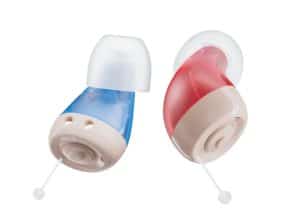
The Differences Between Prescription and OTC
Both OTC hearing aids and prescription hearing aids are FDA-regulated, but they are designed for completely different situations.
OTC hearing aids are meant for adults who believe they have mild to moderate hearing loss. They’re self-fit, self-adjusted, and sold without a hearing test. They can work well for those who want an entry-level device and feel confident they don’t have any medical complications.
Prescription hearing aids are medical devices programmed by a licensed audiologist based on a full diagnostic evaluation. They can treat any level of hearing loss, from mild to profound, and they’re appropriate for patients of all ages, including infants. They come with professional fitting, ear mapping, and tuning to make sure the device matches your exact hearing needs.
You can think of it this way: over-the-counter hearing aids are “one-size-fits-most.” Prescription hearing aids are “custom-built for you.”
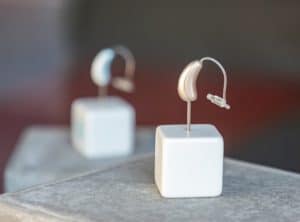
A Hearing Test Should Come First
Even if you feel confident that your hearing loss is mild, guessing your hearing level is extremely difficult. Most people underestimate how much hearing they’ve actually lost, or they assume both ears are affected equally when they’re not.
A diagnostic hearing test at Shoreline Hearing Center is quick, painless, and gives you a precise picture of what’s happening. You’ll learn:
- Your hearing thresholds for different frequencies
- Whether your hearing loss is occurring in the middle or inner ear
- Whether your hearing loss is equal in both ears
- Whether a medical referral is needed
- How your brain processes the information your ears send to it
- Whether OTC hearing aids are appropriate for you
And here’s something else to consider: you may not need hearing aids at all. You may simply need professional earwax removal or treatment for a temporary condition.
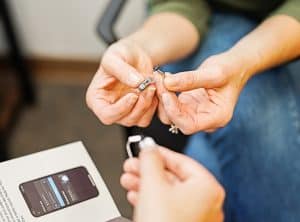
The FDA “Medical Red Flags” You Should Not Ignore
As you decide whether OTC hearing aids are right for you, it’s a good idea to check the FDA’s guidance first. If you experience any of the following, they recommend that you bypass OTC devices completely and see an audiologist or Ear, Nose, and Throat (ENT) physician right away:
- Fluid, pus, or blood draining from your ear in the past 6 months
- Rapid onset hearing loss (for example, you woke up and couldn’t hear)
- Hearing loss that is noticeably worse in just one ear
- Ringing, roaring, or buzzing (tinnitus) in just one ear
- Chronic dizziness or severe vertigo
- Pain or physical discomfort in the ear
- A visible deformity of the ear
- A sensation that your ear is completely plugged with earwax or a foreign object
To be clear, there is nothing intrinsically dangerous about OTC hearing aids. However, putting a hearing aid into an ear that’s experiencing one of these issues may make the condition harder to resolve.
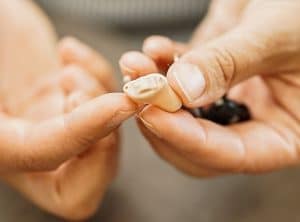
Ready We Can Help You Navigate Your Options
OTC hearing aids can be a great option for the right patient, but they are not a substitute for professional evaluation, especially when any of the “red flags” above are present. If you’re noticing signs of hearing loss, let’s start with the safest step: a baseline hearing evaluation.
Call us at 231-755-0552 today to find out which option is right for you.
FAQs About OTC vs. Prescription Hearing Aids
Are OTC hearing aids safe to use?
For adults with mild to moderate hearing loss and no underlying medical complications, OTC hearing aids can be a safe and convenient entry-level option. They are FDA-regulated, self-fit, and sold without a hearing test.
How are prescription hearing aids different from OTC devices?
Prescription hearing aids are medical devices programmed by a licensed audiologist after a full diagnostic evaluation. They can treat any level of hearing loss, from mild to profound, and are custom fitted, mapped, and tuned to your exact hearing needs, unlike the “one-size-fits-most” design of OTC devices.
Do I need a hearing test before buying OTC hearing aids?
It’s strongly recommended. A diagnostic hearing test reveals your hearing thresholds, whether the loss is in the middle or inner ear, whether it’s equal in both ears, and whether OTC devices are even appropriate for your situation. Many people are surprised to learn their hearing issue is caused by something else entirely, like earwax buildup.
What are the FDA’s “red flags” that mean I should skip OTC hearing aids?
The FDA recommends seeing an audiologist or ENT physician instead of using OTC devices if you have ear drainage, sudden hearing loss, hearing loss worse in one ear, one-sided tinnitus, chronic dizziness or vertigo, ear pain, a visible ear deformity, or a completely plugged sensation in the ear.
Can hearing loss be something other than needing hearing aids?
Yes. Hearing loss symptoms can sometimes be caused by earwax buildup or a temporary condition rather than permanent hearing loss. A professional evaluation can identify the true cause before you invest in any device.